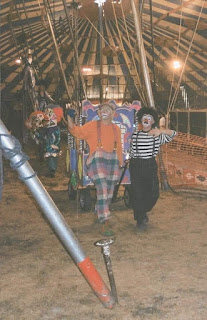
Gideon Sanders and Brandon Magnuson on Clyde Beatty Cole Bros Circus in 1995.
Both were graduates of the Ringling Clown College Class of 1994. Gideon spent one season on the show, and Brandon was there for two, including 1996, which was the last year the show had an all American Clown Alley.
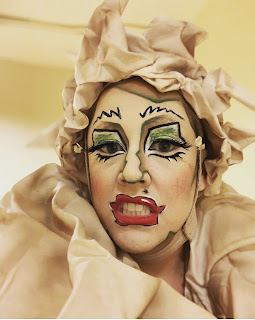
Many well wishes to Emily Carragher, former Ringling, Fossett’s Circus, and Varekai clown, who opens the new Cirque Du Soliel Show, Drawn To Life, in Orlando, FL tonight.
Emily appears as Miss Hésitation, one of the main characters in the brand new show that replaces the long running La Nouba at Disney Springs!
Les Francescos (Francesco, Ernesto, and Enrico Caroli) are some of my favorite clowns. I first saw this act on one of Mike Martin's video tapes about twenty years ago, and I was instantly taken with this trio.
This footage is from the 1966 special, Rings Around The World, in which author John Shawcross reflects on great circus acts he has seen around the world.
I'm not sure on which show this was filmed, but I bet someone out there knows!
Side note: Watching Enrico (the auguste with the mustache) do anything is a master class in clowning.
Here is a short act performed by Mike Smith at the Clown College 1994 Faculty Show in the historic Al Ringling Theater located in Baraboo, WI.
Ringling moved the Clown College to Baraboo from Venice, FL in 1993. The program was located at Circus World Museum, which is the former Winter Quarters of the Ringling Bros.
1994 was the final year with Steve Smith as the dean; Dick Monday took over for the final three years: 1995 in Baraboo and 1996 and 1997 in Sarasota, FL.
Mike Smith was a graduate of the 1989 Clown College class, and he went on to spend two years with the Ringling Red Unit. He and his wife, Lara Heidtman Smith, also came back on the road with Red for six months during the 2000 season after almost the entire Alley (all but three of sixteen) from the previous year had not renewed their contracts.
Mike has performed in many different venues with his friend, CC classmate, and Red Unit Alley mate, Jay Stewart, and he also spent a short amount of time clowning on the Kelly Miller Circus in 2008, filling in for their clown who had not arrived in the country yet.
Jeff Jenkins (CC class of 86 grad, Blue Unit clown for two years, and founder of the Midnight Circus along with his wife Julie Jenkins), can be seen acting as emcee at the beginning of the video.
Francis West, Ted “Zippo” Tutweiler, Dale “Herky” Smith, and Joe “Skippy” Schmidt.
Francis and Dale were both recent graduates of Ringling’s Clown College from the Class of 1987. Ted graduated in 1971 and spent the 1972 season with Ringling’s Blue Unit. He clowned on many mud shows during his life, but I believe he spent the longest time on Kelly Miller.
I don’t know much about Joe, but would love to learn!
Photo credit: Longtime Clown Alley wardrobe man and amazing photographer, Bill Swift
Barbara Nolan (Kinkade at the time), with her dog, Midnight on the Ringling Blue Unit. The photo must be from 1998 because they are posing with her Flea Circus walkaround. The theme of the show that year was Sideshow, so all of the clowns did sideshow themed walkarounds.
Barbara started out as a dancer on Ringling, even participating as the ballerina in the painter soap gag featured in Ringling’s 118th Edition (1988-1989). She attended Clown College in 1995 and toured with the Blue Unit from 1996-1998.
After that she was a part of the Circus Circus Clown Alley in Las Vegas for awhile.
Cirque Alcatraz is in Columbus, GA, which John Kennedy Kane, aka “Eggroll”, informed me is the birthplace of longtime Beatty clown and ringmaster, Jimmy James Plott.
Sorry for the inaction on the blog. I will do better!
Five years ago today, Pat Cashin was taken from us, way too soon. He started this blog fifteen years ago, and although I don’t think I’ll ever be able to keep up with his amount of output, it is an honor to continue posting about clown history in his honor.
Here are some wonderful photos of Pat shared on FB by Paul Gutheil.
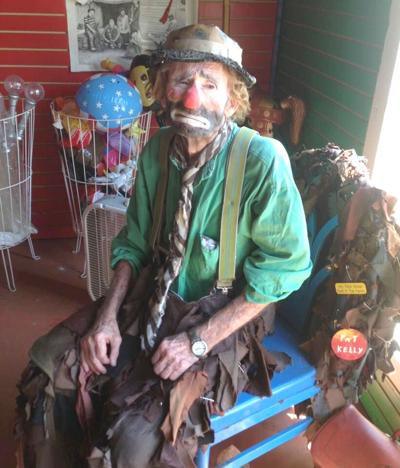
Pat Kelly is shown dressed in his hobo clown costume in this photo provided by Humans of Peru’s Facebook page.
Photo provided
PERU — Thomas Patrick Kelly, the last living son of the nation’s most famous hobo clown who followed his father into a career under the big top, died Sunday at Hickory Creek at Peru. He was 87.
Pat Kelly was the son of Emmett Kelly, whose sad, downtrodden “Weary Willie” character redefined the nature of clowning around the world. Unlike the jolly clowns before him, Weary Willie dressed in tatters, ate cabbage and looked like a down-on-his-luck tramp.
Bob Cline, treasurer at Peru’s International Circus Hall of Fame, said that although Pat Kelly’s clown character was similar to his father’s, he tweaked it just enough to make it his own.
“He was tramp clown, but his mannerisms and his skits were different,” Cline said. “He went out and did other things to make people laugh in his own way. The whole thing with these clowns is that everything goes wrong for them, and that makes you bust out in laughter.”
Pat Kelly started developing his persona when he first clowned in 1954 with his mother, the great circus aerialist Eva Kelly Lewis, in California. But his career officially started in 1958, when he performed in Peru with his stepfather, Joe Lewis, who was a famous cop clown.
The two put on a show outside the Fred Sanger’s department store, which is now home to the Miami County Museum.
In a interview with the Kokomo Tribune in 1995, Pat Kelly said he was “born and raised in clown alley,” and remembers dressing up as a clown when he was just 7 years old. His earliest memories were of the colorful, bright lights of the big top and traveling with famous circus troupes with whom his mother performed.
Pat Kelly is shown dressed in his hobo clown costume in this photo provided by Humans of Peru’s Facebook page.
Provided photo
Kelly went on to perform as a sad, hobo clown in circuses around the nation, including the Shrine Circus and the world-famous wild animal trainer, Terrell Jacobs, whose circus barns were demolished just this year along U.S. 31. He was also a regular act during the annual Peru Circus City Festival in the 1960s.
After decades of performing, Kelly returned to and settled in Peru, where he quickly became the city’s official clown in residence. For the last 25 years, he was the face of the International Circus Hall of Fame, putting on shows and greeting visitors during the annual Peru Circus City Festival.
Although Kelly was famous for clowning, those who knew him in Peru loved him for his gentle spirit and his ability to make just about everyone smile.
“His job as a clown was to bring laughter to the world, and his life revolved around that,” Cline said. “He brought laughter to the world whether he was in makeup as a clown, or not. He was one of the most kind-hearted, gentlest souls you ever met in your life.”
Tim Bessignano, caretaker of the museum in the Peru Circus Building, said it was nearly impossible not to feel better after encountering Kelly, whether it was watching him perform or just chatting with him.
“He made people happy,” Bessignano said. “Some kids got scared to death because he was a clown, but most kids were just tickled to death by him.”
Kelly’s passing marks the end of an era in America’s clowning history that was started by his father in the 1940s. His brother, Emmett Kelly Jr., also took up the family mantel and became a renowned hobo-clown performer who twice put on shows at the White House in Washington, D.C. He died in 2006.
And although Pat Kelly never gained the same kind of fame as his father and brother, he still left a legacy, both in the circus community and in Peru, as a one-of-kind clown who spread joy everywhere he went.
“Everyone is here for just a short time, but he left his mark,” Bessignano said.
The 1999 Ringling Blue Unit Clown Alley photographed by Vince Re. For many years Vince would set up backstage at the arena in Cincinnati, OH to take photos for people on the show.
Pictured are Joel Jeske, Tina Aguirre, Thom Wheaton, Marni Sussman, Leo Acton, Matt Morgan, Lance Brown, David Solove, Gabor Hrisafis, Todd Zimmerman, Allegra Barnett, Cezary Skarzynski, Christy McDonald, Mark Myers, and Josh Zehner.
This article is from 2006 when the Scotts won the Florida Folk Heritage Award.
Wayne and Marty Scott are well known for the superb clown shoes they make for clients all over the country. Living in semi-rural Howey-in-the-Hills, they are “can-do” kind of people. They built their own house, learning each step in much the same way they learned to make clown shoes. They talk to people with experience, use the Internet and library, and inspect things very carefully. Both artists are clowns, and both come from families that are good with their hands.
Although Wayne went to clown school in 1968 at Ringling, he worked for much of his life servicing air conditioners and refrigerators. He also had a good job with General Motors, but the pressure gave him ulcers. Once when he was at home sick in bed, he saw an ad for clowns. In spite of the fact that they had four children, Wayne and Marty decided to pack up and travel with the circus. Marty worked on wardrobe and Wayne performed as a clown.
Being around circus people, the Scotts found a niche for themselves. Seeing a need for clown shoes, they carefully cut up an old pair to see how it was made. At first Wayne worked alone, initially placing the clown shoe over the top of an old regular shoe. When he found out that so few people made clown shoes, he studied how to make cowboy boots, which taught him tricks for his own specialty.
After Wayne had worked alone for seven years, Marty joined him in creating the shoes. Their products are considered excellent because they are individualized, comfortable, and long-lasting—about seven years or more. Clowns become so attached to their shoes that they do not want to give them up. When they become worn, they send them back to the Scotts, who refurbish them. Working as a seasoned shoemaking couple, they can produce a pair of shoes in about six hours. The leather goes on last. It is soaked in water and then put in a convection oven at 150 degrees for three hours to dry in order to get its shape. They use horsehair instead of polyester as stuffing to create the shapes. They say that horsehair doesn’t absorb water like polyester does; therefore the shoes do not get moldy as easily.
Wayne designs all the shoes himself. The Scotts make a large quantity of Mary Jane shoes, which is primary type that Ringling orders. Theyalso make period boots for the Sarasota Opera Company and other opera companies throughout the country. In addition, they create a variety of clown props. Today they are passing their unique skills to younger members of their family.
Former circus clown/owner/dog trainer/management/talent scout and current Circus World Museum director, Scott O’Donnell, on Vidbel’s Olde Tyme Circus in the 1990s.
After a long hard year, the laughs are going to be heard again as the International Clown Hall of Fame and Research Center reopens today!
Exactly 11 years to the day we opened our doors in the circus city of Baraboo, Wisconsin!
Open Monday thru Saturday from 10:00 am to 5:00 pm. Sunday by appointment only.
Pre-Pandemic Prices! $8.00 for Adults, $5.00 for Children under 12.
New exhibits! The largest collection of clown artifacts in the world! As seen on American Pickers, History Detectives, 50 Museums to See Before You Die, Ripleys Believe it or Not and many others!
Father Jerry Hogan passed away last night after a prolonged illness. Through his long career as a circus priest, he became close friends with many in the circus business, especially the clowns.
Father Jerry, thank you for sharing your light, your love, and your laughter with us all of these years. Rest in peace.
Former Ringling Red Unit clown (and boss clown) Dave DeDera talks about his circus career and working in Las Vegas where he has been performing since the mid 1990s.
Emily began her circus career on the Ringling Red Unit in 2006, and also toured with Fossett's Circus in Ireland before taking over the role Mooky Cornish originated in Cirque Du Soliel's Varekai.
She will soon be resuming rehearsals for Soliel's new Orlando based show, Drawn To Life.
This is an interview Emily did in 2015 to promote Varekai's engagement in Fairfax, VA.
Emily Carragher: A clown guide through ‘Varekai’ by Cirque Du Soleil
WASHINGTON, July 16, 2015 – The story behind Cirque du Soleil’s “Varekai,” coming to the EagleBank Arena in Fairfax, Virginia July 22 to July 26, is one of journey and destination.
“It is about self discovery and reaching farther than you can grasp and allowing your self to fail, fall down and get back up again,” Emily Carragher who performs as Clown Feminine says. “My character tries so hard, but she falls – and then gets back up.”
“And that is more important “
30 year-old Carragher, one of the shows two narrators – Clown Feminine and Clown Masculine – has had her own journey. As a child, there were dance classes in both modern and ballet. Then as a teen it was drama classes and high school theater all of which the actor and comedienne credits with helping her to learn to express herself physically.
“Growing up, I liked anything dramatic, the challenge of telling a story through movement,” Carragher says. “ I went to circus camps, and took a circus class during college during which the teacher recommended clown school and I went the summer before I graduated and I got my first job at Ringling Bros.”
Unlike Ringling’s cars filled with clowns, Carragher’s clown, called Mooky after the character’s creator Mooky Cornish, is one of only two clowns that inhabit this wonderful world.
A very short clown act from Varekai feauturing Mooky Cornish and Claudio Corneiro, Cirque du Soleil
Carragher’s sees Mooky as a very empowered feminine character who speaks to the audience, particularly young girls. But she is not your typical show girl with a big red nose.
“She is not traditional show girl shaped, she represents the every woman standing on a stage with the world’s super toned and well chisled people” Carragher says. “She is full figured… and she is different than the other women in the show and I take that as a big responsibility. My smile is the connection I make. It’s the first thing I see, and it is everything.”
She describes her role as being a show within a show.
“The character and I are very similar, each findng the truth in the story playing out on the stage,” Carragher says. “Mooky’s story is the story of a wannabe show girl, someone who dreams bigger than they can hope to reach. But she is also very much an empowered character starting one place and landing someplace else.”
Mooky’s role is to guide us as we watch the whimsical and enchanted creatures that inhabit a captivating forest where the performers seemingly defy gravity and physical constraints.
Varekai, which means “wherever” in Romanian, takes place at the summit of a volcano where a world unique to what we know exists – a world where “something else is possible.”
The story celebrates the nomadic soul via while paying homage to the high-wire acts that take place beneath the more traditional circus tent apex.
Cirque de Soleil brings its trademark strength and physical agility along with incredible imagination to the show’s various acts that include acrobats hurled from Russian swings to fly through the air, contortionists that defy physical constraints, twirling and swinging performers that defy gravity while performing the seemingly impossible, and even a performer who show that even on canes, new heights can be reached.
We watch as a young man named Icarus, borrowed from Greek mythology, lands in the shadows of the forest, meeting the fantasy creatures that take us, as viewers, on to a journey that moves from the absurd to the delightful to the unbelievable.
Icarus, like his namesake, who flew too close to the sun only to plummet into the sea below, has been hurt in his fall. The journey he takes leads him to accept this odd world while overcoming his fear of the different forest denizens he meets.
And, like that Icarus of Greek mythology, our Icarus may learn a bit of humility as he meets The Betrothed, a creature of great beauty. She guides Icarus, and in her giving to the young stranger, discovers her own metamorphosis.
Looking over all that live in the forest of Varekai is The Guide, a wise old man who guides the changes that are necessary for the journey that Icarus is on.
And Mooky is there to guide the audience’s journey of discovery through Varekai.
“One of the more powerful scene is called Nightmare, and it is the most important scene as Icarus meets with the crippled angel. In this scene Icarus sees himself in both the future and present and he is taught what will happen if he does not get up and walk. Move forward,” Carragher says. “Like Icarus Mooky gets knocked down and comes back even stronger. She gets the last laugh.”
Which is important for a clown.
“There is no fourth wall between us and the audience, and when I see young kids in the audience I recognize that I was that kid, and I was in awe, and I hope to do the same for kids,” Carragher says.
Carragher describe Mooky as playful and like many a young child, wants to have a good time. She is very happy, playing against her partner, who is very serious.
“Clown Masculine is much more serious that Mooky,” Carragher says. “And because he is so serious, he create a perfect counter to Mooky’s playfulness.”
Varekai is the creation of a large crew and cast working behind the scenes including:
Guy Laliberté, founder and creative guide, Dominic Champagne, writer and director, Andrew Watson, director of creation, Stéphane Roy, set designer., Eiko Ishioka, costume designer, Violaine Corradi, composer and musical director, Michael Montanaro and Bill Shannon, choreographers, Jacque Paquin, acrobatic equipment and rigging designer, Cahal Mccrystal, clown act creator, François Bergeron, sound designer, Nol Van Genuchten, lighting designer, Francis Laporte, image and projection designer, Nathalie Gagné, makeup designer and André Simard, acrobatic performance designer.
If attending the show with children, first visit the biography pages of these talented people and discuss how they would contribute to a show like Varekai and then have them watch to see if they can see the work of a make up artist, hear the sounds of a sound designer, or marvel at the unique costumes that help to tell a story while allowing the performers to be able to move.
This past weekend I signed up for the Criterion Channel, and one of the pleasant surprises I found was this short film from 1946 about a day in the life of Aristodemo Frediani, better known as Beby.
Beby was partnered for many years with Antonet.
At the time of the filming he is seen performing with his new partner, Maïss, at the Cirque Medrano in Paris, which was a filming location for Fellini's, I Clowns, and also where Buster Keaton performed in the 1940s.
It isn't ground breaking cinema, but it was a fun look at two real clowns of that era. The Criterion Channel offers a two week free trial, and the film is only 18 minutes long, so......
(Also, the film has English subtitles even though the trailer does not)
One thing I love about clowns and comics that came out of vaudeville and burlesque (and also older European clowns) is how polished yet natural their material is.
The Golf Specialist is a perfect example of an act that has been honed night after night on the road until every laugh is milked from the situation.
Domenico was the son of Enrico, one of my favorite clowns, a member of the fantastic trio, Les Francescos.
Ryan and I were lucky to work with Domenico's son, Enrico, while we were in Amsterdam with the Wereldkerstcircus. We loved hearing stories about his family.
Toby Ballantine got his trunk spotted in that glorious clown alley in the heavens today. Son of CC Dean, Bill Ballantine, Toby attended Clown College and taught stilt-walking. He toured with Ringling, Hoxie, Gatti-Charles, advance for Beatty-Cole and worked hard in later years to preserve his parents artistic legacy. RIP