Thursday, April 28, 2016

BEN LINDER: (July 7, 1959 – April 28, 1987)

Courtesy of the Zinn Education Project


“My son was brutally murdered for bringing electricity to a few poor people in northern Nicaragua. He was murdered because he had a dream and because he had the courage to make that dream come true.”

- Ben Linder's mother, at his funeral.

In addition to volunteering as an engineer, Linder participated in vaccination campaigns, using his talents as a
clown, juggler, and unicyclist to entertain the local children. Linder and two Nicaraguans—Sergio Hernández and Pablo Rosales—were killed in a Contra ambush on April 28, 1987. Linder was wounded by a grenade and then shot at point-blank range in the head. Read more and find the free downloadable teaching guide on Nicaragua, including a section on Linder, here: http://bit.ly/1PSeCdJ


Monday, April 25, 2016

VARIETY (April 9, 1909)

Marceline

A national organization is being organized by the circus clowns of the country. The first step was a meeting of the Hippodrome funmakers, under the leadership of Marceline, held in the Hippodrome dressing rooms a few days ago. The purpose of the association is not protection, but social. The following committee was appointed to carry the movement further: Marceline, George Holland, James R. Adams, Clyde Powers and Frank Hansen, of the Hippodrome; Al Miaco and George Hartzell, of the Ringling Bros.' Circus, and Spader Johnson and Fred De Voe, of the Barnum-Bailey organization. Wells Hawks, the public disseminator of "The Hip," furnishes the information.

Friday, April 22, 2016

CLOWN ALLEY: Barnum & Bailey; Variety (April 20, 1907)


The press department of the Barnum-Bailey show last Saturday "pulled off" a publicity-seeking scheme with its clowns, which brought forth comment in the dailies not relished by the funny men. A large auto carried the entire force of clowns to the Consolidated Stock Exchange on lower Broadway, where they disembarked. All excepting Steve Miaco and Bell, of Bell and Henry, proceeded to the gallery, but these two marched in the pit to be marched out again almost immediately after some rough handling by the brokers who did not consider the intrusion comical.

Thursday, April 21, 2016

AL MIACO Variety (April 1907)


    Al Miaco, one of the principal clowns with the Ringling Brothers' show this season is the oldest engaged actively in the ring. Mr. Miaco is father of Steve, at present a principal funmaker in the Barnum-Bailey aggregation. "Miaco" has been a standard circus name for years. There was a "Tom Miaco" years ago, who was a clown, and lived in Cortland N. Y. The history of the Miacos in the show business if compiled would fill a large volume. Everyone up 'York State believes Tom to have been the original clown of that name.


Wednesday, April 20, 2016

SLIVERS OAKLEY: Variety (April 1907)


At the premiere of the Barnum & Bailey show at the Garden last week "Slivers" Oakley, the chief clown, "walked off" in the middle of the performance. Questioned regarding this proceeding Slivers said: "I attempted to do some quiet pantomime work several times, but on each occasion attention was diverted from my efforts by the passing of a number of other clowns with slapstick comedy. This, of course, rendered my efforts void and there was nothing left for me to do but retire. I explained my position to the management and they saw the reasonableness of my attitude. Matter were immediately adjusted and I am now working at every performance in perfect harmony with the others."

Tuesday, April 19, 2016

CLOWN BAND: Ringling Bros. Circus (1897)

    A Symphony in Q Flat

    Being an Attempt to Describe a Subject That Baffles Description.

    Josh Billings wrote more wisely than he knew when he paraphrased an old saying thus: “Music hath charms to soothe a savage, to rend a rock, or split a cabbage.” But “Josh” never heard the Ringling Brothers’ Clown Band, consequently must have taken his “cue” from some wandering son of “Sunny Italy,” whose inspired afflations emanated from the bellows of a barrel organ and breathed out upon defenseless Nature the soul-soothing melody of “Silver threads amongst the gold,” while concomitantly “de monk ” danced the variations.


Clown Band
The Clown Band
But the “Real Thing” really never happened until the year of grace, 1897, when Spader Johnson and his musical coadjutors established that now famous musical organization known as the “Clown Band.” When its organization was completed Euterpe smiled, for the sweet-faced muse knew that the divine art of music, over which she had presided so many centuries, was to rise to heights hitherto unattained, and that the soul of Spader and his symphonious swallows — or, in other words, Johnson and his jabbers of wind would scale the very peaks of the mountains of melody, and from the dizzy heights roll down upon a breathless and expectant world an avalanche of melody and engulf all mankind in an ocean of music. Did the glorious muse divine aright? Well, rather, and why not? Was not this collateral company composed of the very crem de la crem of the musical world? and had they not as director and cornet virtuoso that greatest of all living leaders, Spaderowski Johnsonicola, whom the vulgar once called Spader Johnson? Was the baton ever held in a hand that could so direct the impulses of his players and sway the multitude? When he waved his magic wand with the majesty of an emperor, were not the hearts of his musicians touched like when the winds of a tropical evening awaken into life the responsive chords of an aeolian?

But Johnsonicola was not only great as a director. He had but to breathe into the small end of his cornet, and lo, from the large end canaries seemed to flutter, filling the air with melody so sweet the thousands listened in mute wonder, for the sounds were such as had never been heard on this prosaic earth before, and a poet, who one day heard them, with beautiful sentiment, called them “unearthly.” But the great Johnsonicola could not only soothe his hearers with the sweetness of his playing; he could play so as to make their hearts as light and gay as a May morning, and then again he could touch the hidden depths of human passions and parade before the listener the more somber hues of melody. A man of deep feeling, he could display among the lighter tints the shadows of sadness and make the audience melancholy, so that many of them shed tears, and all agreed that it was very painful indeed. Such was Johnsonicola.

Those whose souls breathed through their various instruments at his supreme command were equally eminent in the musical world. Great among these great ones was Signer Spaghetti Natalie. A native of Greece, he learned as a child to worship art. Beneath that soft southern sky he listened to the native musicians, and on many a moonlit night drank in the melody of the boatmen’s songs that floated o’er the waters to his island home.

The musical nature thus fostered in the land of art was intensified by a residence in later years on Halstead street, Chicago. His instrument was the flageolet. Upon it he was never known to play a tune, but someone — I forget who — said he was h— on after-beats. An ardent worshiper of Nature, Signer Spaghetti Natalie found his greatest pleasure, musically, in reproducing her sounds. Patti could sing like a canary, Jenny Lind acquired the title of the Swedish Nightingale, but no one yet had learned to warble like the great American hog. But Natalie did it with the help of his yellow flageolet and thereby won the name of — but why bestow titles which the great musician’s inborn modesty would cause him to disclaim? Besides the memory of that euphonious squeek will always live with those who heard it. How can it be explained? Imagine a grand symphony played at twilight at the entrance of the stock yards and the porcine plaudits of the inmates blending with the music. Such were Natalie’s after-beats as they marched out in solid columns and vanished in the ozone, gone but not forgotten.

Signer Bickeloni was a fiery musician, if the term may be used. In fact, he was regarded as a warm member — of the band. He could make his cornet talk a language all its own. Signer Bickeloni played with that style and grace characteristic of great musicians. He never had to hunt through the whole scale for a tone, but took the most convenient of the register offered and made the most of it. He was always noted for going right after a tone and hitting it hard. If the tone “sassed back,” which was very seldom, he hit it again and sent it “bing-bang” until lost in the bale ring. His methods seemed to differ somewhat from Ole Bull’s. The latter rather coaxed his tones from his instrument. Bickeloni “never coaxed nothin’,” but, with uncompromising majesty and musical pre-eminence, went at a tone in a manner to make it wail. His methods were best adapted to the somewhat vigorous Wagnerian school. The glory of Bickeloni’s playing was in his trill. Who that ever heard that trill can forget it? It was most conspicuous in the andante passage of Watsonalli’s trombone solo, “Rocked in the Cradle of the Deep” in Q minor. The following bars exemplify the beautiful effect:

Watsonalli — Da rah de rah r-r-r rah da d’ deep,
Bickeloni — Un-tilly-lilly-lilly-tilly-lilly leap.
Watsonalli — De re ruh r-r-row de de duh week,
Bickeloni — Um-tilly-lilly-tilly-lilly tr-r-r-r-r-reap.

The beautiful blending of these two parts can only be imagined by the “way-up-uns” among musical critics. If you are not one of us don’t try; it’s too deep for you. Signer Watsonalli, the world-famous trombone soloist, to whose soul-stirring, omnium-moving genius Bickeloni’s obligate was played, is as original as he is effective. He could make the painful and tearful effects in music even more painful and more tearful than the author intended. In fact, he could depict misery to such perfection that the audience were always miserable during his “effort.” He had that masterful power of reaching out with his music and getting close to everyone within the big tent and compelling attention. No one could escape his magic power. His breath no sooner passed through his trombone than everyone knew it. It was a kind of knowing, too, that left no doubts. Whether the tones were split out in great sheets, stamped out in big chunks, or rolled out in rafts, there was always that positive quality about his music that removed all doubt as to his being all there and getting there too. He was, compared to all other trombone players, like a ripe pumpkin to “yaller” cucumbers.

Signor Lewis Sunlinasco is the name of the famous bass of all basses. Few are aware of the fact that when the Signor arrayed himself under the baton of Johnsonicola a dispute relative to certain technical points in music arose between the two. Sunlinasco believes in the motto, “ Be sure you’re right then go ahead.” He had struck a note on his tuba which he judged was right and refused to vary it, and “ on this line,” said he, “ I propose to fight it out if it takes all summer.” Johnsonicola was forced at last to acknowledge that Sunlinasco could get as great a variety of effects with that one tone as many another could on the whole register.

Signor Zammerti was another famous musician. His performances were remarkable for the great range of his playing. His range was unparalleled. It extended from pedal C to high E and from the bell of his tenor horn to almost anywhere within the confines of creation. Heiser used to listen for it in the stand ahead to know whether the show had started on time or not. The canvasmen claimed that it tore holes in the side wall of the big top as, like a bird uncaged, it burst from confinement and made its unfettered way over the prairies. So much for Zammerti and his range.

This account would be incomplete without a brief mention of the drummers of this wonderful band. Signor Tenori Drumanzi Jonezie was the great solo tenor drummer of the organization. He had, as few know, a most deliciously delicate touch in handling the ebony sticks. Of course no one would dare to criticise such a great artist, but if a suggestion were in order here, it might perhaps be said that his playing was just a shade too classical for the imperfect musical standard of most audiences. He avoided all pyrotechnical displays, which are the usual stock in trade of snare drummers, and confined himself to the music as it was “wrote.”

Signor Jimminie Westo Hitterhardo needs no mention here. His beating of the big bass drum is without a parallel in the history of this most tuneful instrument. He always struck out from the shoulder, and while he was on the strike all season he never once seemed displeased with his job. His crescendos were beautiful, his andantes perfection, and his diminuendos a revelation to musicians and a source of never-ending delight to all who heard him.

Signor Majorbatoni Turnouri, the marvelous manipulator of the drum major’s baton, added to the musically perfect organization a certain degree of finish and imposing grandeur that could not otherwise have been attained. He dropped his baton during the entire season only 12,047,963 times, a most remarkable record. Such was the Clown Band. Will its like ever be heard in this land again? The chances are it may, but hope whispers maybe “ nit.”

Sunday, April 17, 2016

ICHOF: Foolish Fundraiser


"Let us be thankful for the fools. But for them the rest of us could not succeed"- Mark Twain

Six years ago today a great friend of the ICHOF, and Board member, Sandy Weber designed this wonderful logo as we moved forward to re-opening this little place where clowns are celebrated, stories are remembered and lives dedicated to laughter are shared with old and new generations. 
We we opened our doors to the public on May 21, 2010 in our new home of Baraboo, Wisconsin. since that date we have had thousands of guests visit us in person and view the most amazing collection of clown artifacts in the world. We hope they leave with a smile & respect for this art form and share our mission with their family and friends. Our presence on social media has allowed us to bring images and information to potentially millions of people world wide who appreciate clowning as the craft that it is, respect those individuals who's careers have elevated laughter to the most needed medicine for what ails us as a human race, and inspires those who are looking to fufill the calling in their life called clowning.
How perfect the timing that a museum that honors the humor in our lives began on this day known to our society as April Fools Day.
With that, the Board of Directors of the International Clown Hall of Fame and Research Center is proud to announce a "FOOLISH FUNDRAISER" to begin today April 1, 2016 and conclude on the Anniversary day of our opening in Baraboo, Wi, May 21, 2016.
Our goal is for us to raise $10,000 in the next 51 days.
Our 2016 plans include adding substantially to our artifact collections, digitizing and making avaiable online our vast photo archives, the transfer to digital dvd of thousands of feet of rare movie films, new display fabrications and continuation of our Oral Histories project. These goals can only be met with your help.
We will be including incentives to those who can help us reach this attainable dream. Please visit our website at www.theclownmuseum.com where a link to PayPal is located. For today, April 1,2016, in honor of this day celebrating fools, anyone donating $100.00 to $200.00 will recieve a limited edition Jim Howle poster honoring the very first 5 Inductees into the International Clown Hall of Fame.

Titled, "The Pit Stop", it features Lou Jacobs, Otto Griebling, Red Skelton, Emmett Kelly, Felix Adler and Mark Anthony. These are limited edition high quality poster prints.
Every day between today and May 21,2016, the ICHOF will offer an incentive and grateful thank you to those who can donate and help preserve our shared clown heritage. Check back here and on our webpage daily for a suprise and a sharing of clowns worldwide!

Please tell your friends, clown fans and people in your life that could use some laughter!

Wednesday, April 13, 2016

CLOWN ALLEY: Polack Bros Circus (1954)

A Shrine date hospital visit with Professor Charlie Cheer, Harry Dann, Rudy Dockey and Lou Jacobs

Sunday, April 10, 2016

OTTO GRIEBLING: Cole Bros. Circus (August 25th 1937)


Otto Griebling with guest clown, circus fan and Seattle area publisher of the Wenatchee Daily World Rufus Woods who travelled with the show for a few weeks. The photo is available from Getty Images by clicking HERE.

Friday, April 01, 2016

INTERNATIONAL CLOWN HALL OF FAME: APRIL'S "FOOLISH FUNDRAISER From Director Greg DeSanto


"Let us be thankful for the fools. But for them the rest of us could not succeed"- Mark Twain

Six years ago today a great friend of the ICHOF, and Board member, Sandy Weber designed this wonderful logo as we moved forward to re-opening this little place where clowns are celebrated, stories are remembered and lives dedicated to laughter are shared with old and new generations. 

We we opened our doors to the public on May 21, 2010 in our new home of Baraboo, Wisconsin. since that date we have had thousands of guests visit us in person and view the most amazing collection of clown artifacts in the world. We hope they leave with a smile & respect for this art form and share our mission with their family and friends. Our presence on social media has allowed us to bring images and information to potentially millions of people world wide who appreciate clowning as the craft that it is, respect those individuals who's careers have elevated laughter to the most needed medicine for what ails us as a human race, and inspires those who are looking to fufill the calling in their life called clowning.

How perfect the timing that a museum that honors the humor in our lives began on this day known to our society as April Fools Day.

With that, the Board of Directors of the International Clown Hall of Fame and Research Center is proud to announce a "FOOLISH FUNDRAISER" to begin today April 1, 2016 and conclude on the Anniversary day of our opening in Baraboo, Wi, May 21, 2016.

Our goal is for us to raise $10,000 in the next 51 days.

Our 2016 plans include adding substantially to our artifact collections, digitizing and making avaiable online our vast photo archives, the transfer to digital dvd of thousands of feet of rare movie films, new display fabrications and continuation of our Oral Histories project. These goals can only be met with your help.

We will be including incentives to those who can help us reach this attainable dream. Please visit our website at www.theclownmuseum.com where a link to PayPal is located. For today, April 1,2016, in honor of this day celebrating fools, anyone donating $100.00 to $200.00 will recieve a limited edition Jim Howle poster honoring the very first 5 Inductees into the International Clown Hall of Fame.

Titled, "The Pit Stop", it features Lou Jacobs, Otto Griebling, Red Skelton, Emmett Kelly, Felix Adler and Mark Anthony. These are limited edition high quality poster prints.

Every day between today and May 21,2016, the ICHOF will offer an incentive and grateful thank you to those who can donate and help preserve our shared clown heritage. Check back here and on our webpage daily for a suprise and a sharing of clowns worldwide!


Please tell you friends, clown fans and people in your life that could use some laughter!

Saturday, March 26, 2016

SLIVERS OAKLEY: Slivers' Clown Shoes


Photos courtesy of Gene Wolande


Photos of Slivers Oakley's clown shoes, quite possibly the first oversized clown shoes worn in an American circus, in the collection of the Ringling Museum of the Circus in Sarasota, FL


Thursday, March 24, 2016

CLOWN CARS: Billboard Magazine (November 13, 1948)

According to this article Hip Raymond, Kinko Sunberry and Bobo Barnett each took possession of their miniature clown cars within days of each other, all at the end of the 1948 circus season and all built for them by a Mr. Leo L. McKenzie of Wichita, KS.

1948 being the end of Lou Jacobs' first full season of performing his routine.


An earlier "midget auto" built by Leo McKenzie (whose family owned the Wichita Carriage Works)...


Title/Object Name: 
McKenzie Midget Auto
Creator: Unknown photographer
Date Original: Circa 1930
Physical Details: 4 x 3 inches
Description: Group of boys gathered around a miniature automobile built by Leo L. McKenzie. The clown in the driver’s seat and the flags may indicate they are about to participate in a parade. McKenzie built and sold these small cars as a sideline to his business, McKenzie Body Works.
Keywords: Business and industry, children, people, transportation, Wichita.
Subject: Wichita (Kan.) -- Pictorial works
Type: Photographic Contact Print
Collection Name: 
Date Digital: 2003
Identifier: wschm_T3-34.1.8

Mr. McKenzie passed away on January 30, 1977 at the age of 90 in Wichita, KS.


Wednesday, March 23, 2016

AL MIACO: Obituary, NY Clipper (July 27, 1923)


ALFRED FRISBIE MIACO


Alfred Frisbie Mlaco, Al Miaco, died July 21 at his home in New York City. He had spent 66 of his 78 years as a circus clown. Born in Cortland, N . Y., he ran away from home at the age of nine and joined Yankee Robinson's Circus . He started by playing Humpty Dumpty, soon learning to be a contortionist, and then a pantomlmlst. At this time he met the late Al Ringling and became the chief clown of his show, remaining with it for more than thirty years. Every sort of Interesting adventure was his during this long period. He knew John Wilkes Booth, assassin of Lincoln, intimately, and was with him the night before he shot the great President. He met his wife, Laura, 56 years ago while travelling on the Mississippi. She acted as his Columbine for some time and nursed him since the time three years ago that partial paralysis caused his involuntary retirement. He was recognized as the dean of all Shakespearian clowns and won innumerable tributes from his associates, one of whom said, "This man has sense enough to play the fool."

A grandson, Al Renton, is perpetuating the name by appearing as a clown . The funeral services were held Monday and were attended by hundreds of circus people.
When Miaco lived in Cortland, it was a town of about 2,500 population. His homecoming and departure each year to or from the circus were the biggest events of the village.

Tuesday, March 22, 2016

CLOWN ALLEY: "The B.B. Club", Ringling Bros. Circus (circa 1900)

I have seen newspaper accounts describe this as the "Button Boosters Club" but the back of the photo identifies it as the "Button Busters Club" (likely as in 'you'll bust yer buttons') and the Hagenbeck Wallace clowns had one as well.

 "B.B. Club" was a common newspaper abbreviation for baseball team at the turn of the century.

All the performers listed are clowns so some of the clowns either had their own 
social club within the larger alley or this is a baseball team comprised of Ringling clowns


A much better scan from the personal collection of Hank Peare (courtesy of Gary Peare)


Sunday, March 20, 2016

POODLES HANNEFORD: New York Clipper (April 7, 1920)


SETTLE POODLES COMPLAINT


The complaint of Poodles Hanneford, the Hippodrome clown, charging the May Wirth act with infringing upon his material, which gave rise to considerable discussion among both vaudeville and circus folk when it was filed with the N. V. A ., has been settled in favor of the Wirth act. According to the decision of the complaint board, the infringements which Hanneford claimed against the Wirth act have and are being used by scores of equestrians. Expert testimony was given to this effect by Charles Ringling, Toto, and a number of other circus folk. However, it has been suggested that Phil, the comedian in the Wirth act, change his makeup, which, it was contended, is identical to that of Poodles .

Saturday, March 19, 2016

TOTO: Hollow Tree


Courtesy of Past Tense

Autographed photo of Toto the Clown, at the Hollow Tree, n.d.

Toto’s real name was Alfonso Novello. He was born in Genf, Switzerland in 1888. He starred in comedic shorts for filmmaker Hal Roach, and started in vaudeville in 1918. His act included a dog named Whiskey, who rode along with Toto in his clown car. Toto headlined at the New York Hippodrome and the Palace Theater. He died in 1938 while in the process of suing the New York Daily Mirror for mistakenly reporting his death.

Friday, March 18, 2016

HUNTING GAG: Los Angeles Herald (November 13, 1907)


Charlie Bell: Hunting Gag August 14, 1947


DOG MADE UP AS RABBIT SCORES HIT AT CIRCUS


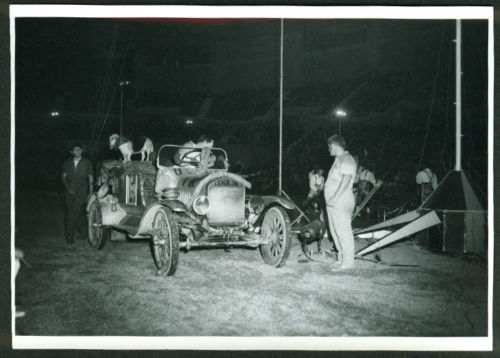
One of the cleverest acts in the Norrls & Rowe circus yesterday was that of Toto Ducro, clown. Ducro has a dog made up to represent a rabbit. The clown goes on a rabbit hunting trip and is followed by the rabbit dog; the clown sees the rabbit; it sits on its hind legs; the clown takes aim; fires an imaginary gun and the rabbit falls over as If shot.
The clown goes to the supposedly dead rabbit and picks it up and throws it carelessly down. The rabbit does not move from the position in which It falls, but as soon as the clown walks away the rabbit follows him again. It is a new and novel act and is the finest specimen of animal training seen in years.


Lou Jacobs and Knucklehead: Hunting Gag 1977


Thursday, March 17, 2016

PETE MARDO: Hopkinsville Kentuckian (October 20, 1914)


Pete Mardo, a Famous European Clown Coming

With 
Ringling Bros. Shows.


Once each month the clowns of Ringling Brothers' circus, which is coming here Wednesday, Oct. 21, hold a meeting and elect a "joke editor." It becomes the duty of this official to buy all the newspapers procurable and to read them religiously. Whenever he comes upon a topic which, might serve for an up-to-date parody or humorous caricature,
he puts it aside.

Every afternoon at 
1 o'clock there is a meeting of what is known as the "sawdust senate." This is composed of a committee of twenty clowns selected from the entire army of jesters. The "editor" makes his report to this body and
they discuss it and select those ideas which may be turned to account on the hippodrome track.

This is the secret of the down-to-the-minute 
performances of the Ringling Brothers' skylarkers. There is not a fad of dress, dance or unusual innovation which they do not portray in some ludicrous manner.

They pantomime public and political 
events, but with so much good humor that the bitterest of factionists pound each other on the back and roar with laughter. The clowns do not fear to enter the land of invention, but introduce gaudy painted airships which skim around in the tent top and explode while in mid-air. They flit around the hippodrome track in queer looking racing cars, throw terrible looking but quite innocent bombs, and shoot each other
from big wooden cannons. They mimic everybody and everything.

Sandwiched between the gorgeous
ness of the new spectacle of Solomon and the Queen of Sheba with its cast
of 1.250 characters, and the daring of the areanic displays, these Merry Andrews temper the entire circus program with the rarest of comedy.

Monday, March 14, 2016

HAGENBECK-WALLACE CLOWN ALLEY (1924)


Art Borella


Shorty Flemm . Ernest LaDoux , Kid Kennard , Bill Hart , Joe "Koko" Coyle . Art Borella . Joe Gould , Friday Wright , Art Potter , John Potter , Bill Potter , Walter Goodenough . Earl Shipley . Ray McDonald , Louis Plamondln , Abe Arononson . Billy Henderson , Charlie West , Dick Pinckney , James Duggar . James Thomas , Chester "Bobo" Barnett and Wallace Cobb


Joe "Koko" Coyle

Sunday, March 13, 2016

THE NEW YORK PLAYER: Ringling Bros. Show Long On Joeys (May 16, 1913)

RINGLING BROS. SHOW LONG ON JOEYS


Clowns Attracted an Unusual Amount of Attention During Engagement at Philadelphia Last Week 


PHILADELPHIA, May 10 . —Although every number on the program of the Ringling Brothers Circus delighted our people this week , the clown contingent this year is made up of such a list of talented performers that it is worthy of special notice . Their mirth-provoking antics cannot help but convulse people in all parts of the United States the same as they did here all this week . Al . Ringling always had a soft spot in his heart for an accomplished Joey and , as he knows that the paying public love to see the clowns , he has secured the foremost in their line in this show . To describe the many big numbers put on by the clowns would be difficult for when they are given the hippodrome track to work on , every portion of it is covered by the funny men in new and novel side-splitting diversions . An individual list of the many clowns with the show this season will prove interesting and valuable . Their names and the individual characterizations they assume , follows : Al Miaco , the youngest old clown in the business , who has been amusing the people of the United States since he was a boy—and that was many , many years ago—is giving an effective picture of William Jennings Bryan this year , besides joining in the group fun-making ; Billy Carroll , another clown who dates back a number of years , uses his individual specialty , the Two Headed Policeman ; George Hartzell . the Beau Brummel of clowns ; Horace Webb , who does the effective aeroplane specialty ; Fred . Stelling , butterfly ; Jules Tournour , pantomime clown ; Max Delea , The Strap-Hangers Plight ; Ed . Allen , rag artist ; Louie Plamodon , The Ride on Mothers Back ; W . Baird , trained pig ; Bert Leo , trained goose ; Sam Roberts , suffragette ; Paul Minno , eccentric dude ; Billy Jamison , giant fire-cracker ; The Three Mardos , Morning After and bath-tub ; Mickey McDonald , big-headed man ; Ed . Walton ; parcel post carrier ; Rollie Wilson , alligator hunt ; Alex Brock , three-legged sailor ; Eddie Nemo , long-legged man ; Jimmy Sprigs , old policeman ; The Two Casinos ; racing horse and pigs , Denny McPride , Ed . Nathers , Johnny Tripp and Earl Bambard .

Thursday, March 10, 2016

CLOWN ALLEY: Ringling Bros. and Barnum & Bailey (1922)


As confirmed by the New York Clipper March 29, 1922


Arnt Augestad
Felix Adler
Buck Baker
Tony Martin
Roy Barrett
The Six Casinos
Charlie Cheer
Harry Clemings
Jack Hedder
Al Sylvester
Ted Marchant
Gene Dekoe
Andrew Deltorelli
Joe Deltorelli
Tom Hart
Everett Hart
George Hartzell
The Three Jungs
The Three Harddigs
Spader Johnson
Jack LeClair
Jack Lyons
Willie Moser
Eddie Nemo
Fred Meers
Herman Poline
The Rice Trio
Billy Rice
John Slater
Joe Spissell
Jim Spriggs
Joe Stirk
Joe Arena
Charles Smith
Fred Stelling
Jules Turnour
H.A. Thompson
Pat Valdo
Fred Voody
Al White
E.W. White
George Zammert


Tuesday, March 08, 2016

IN MEMORIAM: Frank "Slivers" Oakley


The world lost Francis "Slivers" Oakley 100 years ago today. The fundraising effort held here on clownalley.net this past weekend raised over $3,500. to provide both Slivers and Nellie with a tombstone. We've been asked to leave the GoFundMe site active so that others can continue to contribute with any funds left over after the instillation earmarked for an International Clown Hall of Fame fund for future projects of a similar nature.

The Oakley family wishes to extend their most heartfelt gratitude for the generosity of the international clown community in coming together to honor Slivers and Nellie's memory.