Wednesday, February 22, 2017

An Interview With The 1908 Barnum & Bailey Clown Alley

The following interview appeared in several newspapers across the country in early April of 1908.  I think it's interesting that a woman is conducting the interview.  The clowns are socially awkward.  Hardly anything has changed in 108 years.  HA!  108!  

Before we begin, here's a listing of all 36 clowns who were in the alley that season 
(this is a clipping from the 1908 Barnum & Bailey program)

NEW YORK, April 4 - Many of the costumes that the Barnum & Bailey clowns offer for the inspection of the people who come to see them are worthy of special mention.  They are the very last cry in things sartorial, and if broadway does not copy them, well, it's a loss to the world of the Great White Way, that is all.  Here's a chance to get away from the rule of the conventional.
     One of these outfits has a waistcoat of large plaids.  It is worn with a coat of elephant's breath that has short bobby tails wired to give the required nonchalant air.  The trousers are modestly high and only exhibit four inches of snow white hose.  A long, light wig lends distinction.  The shoes are of the flapping kind.  Color, hay.
     A frock coat of the vintage of 1812 is worn with a dark red sweater, champagne-colored stockings and no shoes.  A mule, heavily belled, should accompany the wearer.
     With a swallowtail cut to half the usual length at the back, a bright red necktie with flowing ends is very effective.  This should enclose collar with six inch points, built so as to hold the head very erect.  Large loose shoes that beat time with the walk and visible stockings are worn.
     Thin white batiste with many frills.  Red belt drawn taut over expansive waist girth, black stockings, flap shoes, small linen cap set flirtatiously on the side of riotous yellow curls.
     A policeman's coat is worn over tip-tilted bustle and shoulder pads.  It has three rows of buttons down the front, the middle row very small.  A blue flower on the left breast gives a Paquin-like air.  A clay pipe and whiskers are absolutely indespensible.
    With the radiance of this accumulation of fashions and folly in the eyes, it is hard to realize that the rows of men who sit silently in the press room after the circus is over are the very ones who a few minutes before flaunted their magnificence before thousands of spectators.  All the white zinc and grease paint has been washed off, and the prismatic attire replaced by the common, ordinary Maison Square Garden kind of business suit, a little the worse for wear in a few instances, showing the storm and stress of life on the road.
     There is not the slightest attempt to get away from the current mode.  Everything is rigidly conventional and correct.  Each one of them has a clean shave, a shoe shine, and immaculate linen.
     There are fat men and thin men, old men and young, those experienced in circus ways and those to whom life has still something to offer besides a weekly salary and a problematic engagement for the next season.  But the cheerful ease of the ring is replaced by what in circus talk is called sawdust fright.
     It is caused by the unusual experience of being interviewed.  All the merry quips and cranks which people ordinarily associate the genus Clown are gone.  They sit on the extreme edges of their chairs and wait for each other to speak.  When one ventures, after explanatory cough, the rest admire and envy his eloquence and self-possession.
     "If we'd only known about it two days ago," one of them confesses, "we'd had a chance to think up something to say.  Lord, lady, we've got stories enough.  Some of us's been more'n forty years in the clowning business.  But you can't think of stories right off the bat, begging your pardon, this way."
   
Then they introduce themselves and each other.
     "Lady, I'm the policeman, the jockey and the ballet girl."
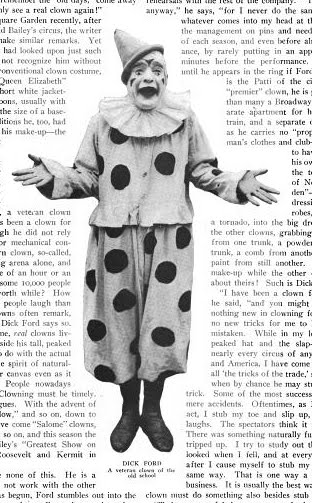
Dick "Foolish" Ford
     "I'm the man with the long rope and the short dog.  My! But I thought he'd bite my ankles today, exposed as they be."
     "I'm the one whose feet flap the most."
     "I'm Foolish Ford.  In my contract it says that I can come and go ad lib."
     "I call myself the most absurd, ridiculous individual in the world, abounding in the melody, mirth and madness.  Then when people say I'm so bad I'm good I don't have to make apologies.  I just point to my explanation that's written in the posters."
     "I'm the man that's got a sort of cousin on Park Row who gets all his funny ideas from me."
     Others content themselves with merely saying names, Austin Walsh, Arthur Borella, Fred Egener, Stanley, Baker, Gerome, Bennack, Ackley, Clemens.
     The tall man who is looking for some pictures of himself in the press album continues the apologies for being unprepared.  "We ought to have written the story ourselves," he adds, "and given it to you to fix it up if you think it needed it.  We're great on monologues.  We could have done you some corkin' ones if we'd only known.  Next year if we're with the show and you want us to--"
     The rows nod approval.
     "Is it to be a long story," another ventures, "or a short one?"  They all lean forward for the reply.
     "Oh, a long one with pictures."
     They are visibly more interested.  One or two prod the others to speak.  "Go 'long, Ford; you oughter have a heap o' things to say."
Arthur Borella
     "What's the matter with you, Arthur Borella?  Tight as a wad."
     "Look at Freddie Egener over there, dumb 's a clam.  He's got enough to gab about in the Clown's alley when we want him to shut up."
     "Oh, Austin's going to chirp.  Don't be afraid, Walsh.  It's all right.  Lady won't hurt yer.  Walsh's got the floor.  What, he's backed out, too?"
     "Well, I don't know, lady.  It's tough for you, and with pictures coming our way too.  Lord!  Seems as if we'd ought to think of something.  The trouble's right here, now.  We'll tell you.  There ain't nothing new in the business.  Clowning's the same story, year after year."
     "Oh, yes, of course we go to different places all over the world, in fact."  It is Foolish Ford who is speaking, a middle-aged man, with a deeply furrowed face and kind gray eyes.  "But it's all the same to us.  We don't care whether a town's up or down.  I'm thinking of San Francisco when I say that.  I was there before the earthquake and I was there after it.  Didn't see any difference to talk about.  Up above the ground or down below it, what's the odds?  It's just a town, that's what it is.  Now, I've been in London a heap o' times.  Lived right near Westminster abbey; and all last season I was so English that I had my trunk marked 'Sir Richard Conneford, Liverpool, England, but I never went near the abbey to go inside.  I don't know why clowning makes you feel that way, but it does.  You get so gol-darn tired of places where George Washington was shot and Abe Lincoln was born that you just leave 'em for the rubber-necks."
     "And, then, besides, we're thinking,"  This is from one of the other thirty-five clowns, "You see, when you're a clown it's up to you to think up something original, for no matter how good a stunt you may have you can't go on doing it forever.  You've got to have something every bit as good as you had before and a heap sight better.  It keeps you guessing in your spare minutes."
  One or two wipe off the perspiration from their brows at the memory thus evoked.
  "Some of the salaries of the clowns run as high as $100 a week, some don't get more'n $35.  The cleverest clown is the one that fools the manager the best.  He is the best if he can do that, for it ain't an easy trick.  He's stopped fooling and is the real thing.  Have you got that down?"
  "The way a clown does is to think up something smart and then submit it.  You needn't think it'll go because you write a letter sayin' it will or because you laugh at yourself."  It is the inventor of the rubberneck coach trick who now has the floor. "We tried that trick first in Brooklyn and they laughed at it and then we were up a tree because we thought it wouldn't take in New York, but it has.  New York's the ticklish place.  Take a trick all over the country and get a laugh wherever you strike the tent poles, and then tote it over here to this burg and you get the frozen mitts.  Then, again, some fool thing that the country jays would be ashamed to smile at will bring down the whole Garden.  People'll go home and talk about the button bursting clown comically for a week and bring over their mothers-in-law to see it."
     "Have you been to Paris, Lady?"  interrupts one whose name is unknown, "and did you ever get knocked down by a cab and get arrested for blocking traffic and fined for it?  Well,  that would remind you of one of the many joys of the merry clown's life.  If he gets kicked by a horse that is showing off in the acme of expert equitation and acrobatic equestrianism, or if he is knocked over by one of those graceful little Roamin' chariots, or perhaps if a trapezist in his marvelous aerial act forgets and falls on him instead of the net, why everybody wants to know what the clown's doing in the way there.  What business has he got to be under feet and interfering with the legitimate business?  It's up to the clown to look out for himself and when you've got everybody in your neighborhood interested in your stunt and you can only hold 'em there for a minute or two by the power of your marvelous personality, it's mighty hard work to have to be eternally and forever trying to crawl out from under the weight of half a dozen animals of one kind and another.  Lots of times I've taken my new costume, before anybody else had a chance to see it, and walked up and down in front of the horses so that when I did appear the wouldn't be too surprised and mistake me for the sawdust in their admiration or fright, whichever it might happen to be."
     The clowns are beginning to loose their fear.  Another would-be speaker can scarcely wait for his turn.  "You see, the old-time clown, which we nearly all of us used to be, was a one ring clown.  His stunt was to come out and talk with the ringmaster, and between them they managed to fire the changes on all the local gags and the jokes.  He would interpolate a comic song now and then and answer back if anyone asked him a question.  It was hard work, but it didn't begin with the work of the clown today.  Now it's action, something doin' and doin' quick and hard.  You've got to get a laugh as soon as people look at you.  You can't give 'em a chance to go home and talk it over and come to some family decision.  No sir-e-e.  So our surest way is the makeup, for the modern circus is too big to have talk in.  You wouldn't be heard.  A clown has to get up his own rig, buy it or have it made; then it belongs to him, and the value of a clown is oftentimes measured by the amount of funny costumes he has in his repertory.  Here at the Garden I suppose every clown has four or five changes which he puts on in the course of one show, never appearing in the ring in the same gown.  We don't spend much time browsing about libraries of Fifth averner auction rooms, but some-times we do get an idea from a cartoon, and junk shops are our favorite hunting ground.  Anything funny that we see we get and hang on us.  Many of the costumes are very expensive, $35 or $40 maybe, and as they don't last long the accumulation of this property represents quite an item of expenditure.  We do economize oftentimes by using one year's costume for the next season's rainy day suits.  That's our only way of getting anywhere near ahead of the game.  And if you get a funny idea be sure that it will be copied right away.  The flap feet when they first came into the business made a great hit, but the season wasn't over before every clown in the country was flapping his feet, as if he'd invented 'em."
     The policeman breaks in, " I suppose I'm considered the funniest clown in the the business."  There is a little choking sound heard from the rows, but it does not break out into articulate speech.  "This makeup of mine's a direct inspiration.  I was calling on a lady friend and telling her that I was looking for a long coat.  She was a good sized woman, somewhere near 200 pounds, and she opened the door of the wardrobe and showed me her last year's garment hanging there.  It was all right but the color, and she suggested that I have it died, which I did.  Then I sewed three rows of buttons
Harry LaPearl with his wife Loretta
down the front.  The small row in the middle, and borrowed from another lady friend her bustle and shoulder pads-the first one didn't have 'em in stock for obvious reasons.  You see what a success it is.  The children simply love me.  It's a queer thing about them kids.  Just as soon as they get old enough to throw a stone they're on the lookout for a cop to throw it at, but let there be a policeman clown, they can't see him too often.  They just go crazy over him."
     It is while the subject of children is being discussed that a letter is brought in by one of the officials, who reads it aloud.  It is from a Harlem parent who has lost two boys and thinks they must be with the circus.
     After its contents have been thoroughly digested by the assemblage there is a deep silence.  Walsh looks quite fussed up about it and Egener crosses his legs and uncrosses them nervously.
     Finally there was a chorus of protesting voices:  "oh, of course they've run away with the circus.  Led to their ruin by the clowns' talk.  Whenever there's a circus in town and the boy's mislead of course he must have joined.  And why do they always think they're going to be clowns?  It requires some training to ride bareback or swing on the bars but non, of course, to be a clown;  oh, none at all.  Think of it!  As if we don't have troubles enough without stealing children to train."
     "Well, but," begins a mild-voiced clown in the second row, "we couldn't get along without the kids.  That's true enough.  They come pleased in the beginning and all you've gotter do is to take a little notice of 'em, wave a day day and they're with you from start to finish.  No weary work trying to smooth out the glassy stares.  I remember one orphans' day.  Well, lady, I've been clowning now for some thirty odd years, and when I think of it I get a queer sort of feeling somewhere.  It was a benefit performance and a whole foundling establishment was there-- courtesy of the management.  How they did enjoy it!  Didn't seem to have too much fun in their lives, and they laughed as if it had been bottled up for a long time.  After the show was over the manager asked me as a great favor if I'd stand at the door and shake hands with the children as they went out.  Would I?  You bet I would!  I never enjoyed handshakes like those.  One by one the kids sidled up, some scared as could be, some brazen; those were the ones who were going to be clowns when they growed up.  Some of the littlest ones hesitated, not through fear--oh no--but they wanted to--what do you think?  Sure, kiss me!  Did I let 'em?  I lifted them one by one in my arms and they kissed me so hard that when they got through all the white zinc was kissed off in a smooth circle all around my mouth.  But what did I care?  White zinc's cheap, but it ain't often that a clown gets kissed that way; not often, lady."
  "Is it a clown's ambition to play Hamlet?  Not on your life!  We ain't any of us hankering after them melancholy parts."  This is from the stout clown with the polka dot tie.  "A clown's ambition is to play with the Barnum & Bailey show.  All through the country you'll see them with their eyes fastened on the point of the compass where the great show's billed.  When the offer comes to join that aggregation of wonders, a clown feels the same way that an actor that's been doing one night stands for fifteen or twenty years does when he's invited to play on the Great White Way and is guaranteed by the management that he won't have things thrown at him."

"How do we begin?  Well, we're willing to tell that if you'll promise not to ask how we end."  This is from one Egener in the rear, who looks as if his clowning had never interfered with sleep and appetite.  "It--well, it was a good many years ago and I didn't know anything about being a clown except that I wanted to be.  There was a little show in town-- in the middle west--and I put some glycerine and oxide of zinc on my face--I knew that much--and applied for a place, hearing that there was at that time a deficit of clowns.  I told the manager that I was great on the gab and could sing like a wren.  He hired me on my nerve and offered me $12 a week, which I took, after some hesitation.  I wasn't getting anything at the time and it seemed bigger than any salary I ever got since.  I made a great hit with my song, which was in the days before it got too common.  It ran:  'Willie had a little gun--now he's gone, gone, gone.'  The manager told me he considered me the greatest clown in the circus world, but he said it with one eye closed.  I drew my salary for six weeks regularly, then there was a lapse for sixteen, and I could only touch the manager for about two bits a day.  At the end of that time I went home in a box car and put my trunk in pawn before I started.  Same with you fellers?  Beginning's nearly always identical.  Next year I got $35.  Same with you fellers?  Thought so."
     The dark man who speaks next was with Walter Mains show in the beginning.  "I was in the concert that took place after the show, and one day it occurred to me if I could make $12  week for that, why couldn't I make $35 being a clown?  I put it up to the manager and he gave me a try.  I succeeded and am now at the top of my profession."
     There is a decided movement of disapproval.  One says:  "We ain't sayin' you ain't, but the profession of clowning is different from a turnip in that it has more'n one top."
     "Got that down in your notes?"  says the tall man, "for if you ain't, think I may use it myself.  We're always looking about for chunks of wit, for when the circus season is over nearly all of us go into vaudeville, and some of us have even tried the legit.  I played two seasons in Wilkes-Barre, Pa., in a temperance drama called 'Dot, the Miner's Daughter.'  The neighbors said I was good but the general public agreed with my family.  I never went back."
     "Some people think that the clowns live together, herded like freaks, and I met someone around asking for the clowns' boarding house.  The truth is that most of us have been born and brought up in the business.  We married in it and our children are taught the circus stunts as soon as they begin to walk and talk  but we'd all of us like them to go into the legitimate and make a name for themselves, get away from them long footprints of the one-night stands and the seasons on the road."
     "We don't any of us retire rich.  Barney Baruato, the South African millionaire, was the only one and the disappointment of riches or the contrast between his life as was and is made him commit suicide in midocean.  There's many of us have left clowning for good.  Richard Golden and Billy Clifford, for instance, but perhaps you'd better not mention their names and give 'em free advertising."
     "The only real excitement of the clown's life begins when he starts in betting.  Every Saturday night in Clowns' alley, as we call the clowns' dressing room, we bet on the number of weeks and the town where the circus'll end.  It's in the Clowns' alley that all special announcements are made and anyone has the privilege of stepping on the table and making a little speech.
     "The isolation that has been thrust upon us by herding us together in a dressing room, where the proclivities for covering everything with white won't interfere with the rights of others, has resulted in the making of many fine orators and monologuists, whose talents are unknown to the general public."

Wednesday, February 15, 2017

Gordon Bunch, Whiteface Clown of Color

Courtesy of the Tennessee State Library & Archives

There have been many African American clowns, but before Brian Wright, Jamarr Woodruff, Sean Davis, Gregory Parks, Onionhead, Huel Speight, Danise Payne, Reggie Montgomery, Bernice Collins, Dusty Fletcher, or Bert Williams (and many more) - there was Gordon Bunch.


Gordon Bunch clown at Jim Key Worlds Fair 1906
at the 1906 World's Fair

Gordon, to my knowledge, is the first man I can find record of being an African American "clown", calling himself as such, who wasn't just a white man in blackface like Eph Horn.
click to enlarge
In 1904, he was booked as a clown and pantomime artist at the St Louis World's Fair, promoting their top money-making exhibit: Beautiful Jim Key - The Educated Horse.  The horse was formerly owned by P.T. Barnum himself, and was purchased and raised by slave-born African American veterinarian Dr. William Key.  The horse could spell with letter cards, do math, and make change from a cash register.  According to a November 1904 St. Louis Republic newspaper article about clown acts at the World's Fair, "Gordon Bunch, whose pantomimic feats in front of Jim Key, and his excellent makeup as a clown, have been most attractive, is another old-timer in the profession, and his work during the summer has been remarkable at producing results at the box office".

If he was an old-timer in the profession in 1904, I wonder how far back his career went?  More research!

After the World's Fair, Bunch accompanied the horse on a midwestern tour, reaching Minneapolis on March 30, 1906, along with veterinarian Stanley Davis and groom Sam Davis.


Not long after, Bunch performed at Luna Park in Cleveland Ohio.  A reviewer called him "one of the good clowns."  He also took his clowning to the vaudeville circuit.  I found the following account of an adventure he had one night, posted in the book "Blacks in Blackface: A Source Book on Musical Shows" :

Indianapolis Freeman
April 9, 1910
Gordon Bunch-To the Rescue-Saves Life of White Woman-Gets in Bad
Recently while playing a vaudeville house in a small town Gordon Bunch, America's only colored ragtime clown and versatile comedian, met with an accident that goes as follows, from his own pen:
     "While doing my clown act in a vaudeville house in a small town where they don't like colored people to stop overnight, the theatre caught on fire.  Every-body got out safely except one young white lady, who was left behind.  Although I was in my make-up, I rushed back into the burning building and brought the young lady, who was half dead to safety in a few minutes.  She came to herself, then asked to kiss the man who saved her.  I was standing among the crowd, removing the make-up from my face the best I could, when she came to where I was standing.  She looked at me and then cried, 'It's a coon!' and fainted.  Afterwards I was held over for twenty-four hours for causing the young lady to faint.  However, I am faring exceedingly well and going big everywhere."
Courtesy of the Tennessee
State Library & Archives

He was billed as "The Mysterious Komedo - The Mechanical Wonder" on the vaudeville stage.  I found record of this act in the November 20th 1916 issue of the Xenia Daily Gazette (Xenia, Ohio) under the COLORED SOCIETY column-

  Hundreds of people were attracted to the windows of the Adair Furniture Company, Saturday evening, and marveled at the appearance of Mr. Gordon Bunch.  Mr. Bunch was made up as a mechanical figure or "dummy" in such a way that it was impossible to detect wether he was real or artificial.  On this coming Thursday evening, Mr. Bunch will present his big feature, "The Power of Man," at the opera house.

According to census records, he was listed as a "Ticket Taker" in Cleveland, Ohio in 1917.

Mr. Bunch, you will not be forgotten.  I hope further research proves fruitful!

Laughs for the Left Behind Variety Show April 8!

For those who do not know, Pat Cashin, the namesake and creator of this blog, passed away unexpectedly over six months ago.  His friends are putting together a comedy variety show dedicated to him on April 8 in New Jersey.  Here is the rundown:

Save the Date for something that will be very very special.
MotionFest and other friends present

Laughs for the Left Behind
A celebratory comedy show to benefit the family, friends and community Left Behind by the unexpected July passing of Patrick Cashin.

April 8, 2017
8 pm (an earlier show may be added in the afternoon)

Seashore Day Camp and School
404 Broadway
Long Branch, NJ 07740

Laughs for the Left Behind logo stickers to be worn on your left buttock will be available on site.

Here is the first release of performers rostered for the April 8 Laughs for the Left Behind show:
Hilary Chaplin
The NY Goofs (Dick Monday and Tiffany Riley)
Jeffrey Gordon
Bill Irwin
Kevin Carr
Greg DeSanto
Archie Cobblepot
Joey Klein
Fritz and Stephen (aka Eepybird)

Plus more soon to be released

More info soon!

Please note that all performers listed are scheduled to perform, but this lineup is subject to change.

Sunday, February 05, 2017

2 Scenes, 1 Gag

Behold, the power of adaptation!  The following clips show the same two clowns doing virtually the same routine as part of two separate productions and situations.  The clowns are James Thierrée (grandson of Charlie Chaplin) and Magnus Jakobsson.  The first clip is from La Chauve-Souris, an adaptation of the opera Die Fledermaus, directed by Coline Serreau (who wrote Trois Hommes et un Couffin which was re-made in Hollywood as the Tom Selleck classic "Three Men and a Baby").  The scene involves a man trying to escape an ugly woman who wants to dance with him. 

The second clip is from La Symphonie du Hanneton, in which a man is asleep dreaming and a stranger keeps entering his dream space. 

Sunday, January 22, 2017

Sic Transit Gloria Mundi

"Thus passes the glory of the world"-  these words are used to mark the passage of life onto the next phase, sort of a 'this too shall pass."; most historically during coronation ceremonies of a new Pope.  These words are also in popular culture as seen in Wes Anderson's film Rushmore, and even in the popular Blizzard game 'Overwatch', each time Soldier 76 re-spawns.  How do these words pertain to clowns?
With recent waves of "scary clown sightings" and the recent fall of several circuses, some ask, "is clowning dying?" or "is circus dying?"  The answer- to survive it must evolve and adapt.  I accidentally came across the following article, in which the style of clowning had to evolve as the circus did 132 years ago:


Chicago Tribune, March 29, 1885

THE CLOWN HAS HAD HIS DAY:  The Double Circus-Ring and the Wealth of Attractions Killed Him

New York Mail:  "It is a sad fact," mournfully said a veteran circus manager, "but it is beyond dispute that the days of the joke-cracking and song-singing clown are over.  He expired when the double circus-ring came into vogue.  In his place the horse-play or pantomime Grimaldi arose."
"How did the double ring kill the witty(?) clown?"  asked a reporter for the Mail and Express
"The vast audience could not hear him.  The miles of canvas, the ampitheatre, filled with 10,000 people, made the great lung power necessary to be heard an utter impossibility.  The large railroad travelling circuses have nothing but pantomime clowns.  In the small shows, where actors are few and something must be done to fill the time for the acrobats or whatever they may be to rest, before they appear in some other daring feats under other dazzling names, the song-singing, punning clown is used.  But he is fast going out for other reasons.  The newspapers and almanacs contain nearly all the jokes and puns and to repeat them in the ring over and over again becomes monotonous and tires even those who do not read.  Thus to supplant this, horse-play was invented."
"What do you mean by horse-play?"
"Broad humor.  For instance, the clown sticks a needle in a chair, and the ringmaster innocently sits down on it.  He gets up in a hurry.  This kind of fun tickles the audience.  They see it and understand the point made, but it is not so with a pun of joke.  I was a clown before I became a proprietor and I know all the inside tricks of the profes(ion).  When I traveled in the small towns of 8,000 and 10,000 inhabitants I always managed to pump some garrulous man in the town before the performance, so as to get off a local gag.  This always pleased the audience, and occasionally caused a little row if the 'gag' was at the expense of some fellow in the audience.  Then I would sing a song and hear all the little boys in the streets singing it afterwards.   There was some glory in that, but now the clown must be a first-class tumbler and a good pantomimist to succeed.  He sinks his individuality with some ten or fifteen others, who come out caparisoned in caps and bells.  The lines are drawn and the old order giveth way to the new.  Grimaldi's mask has more fun in it than Dan Rice's double entendre jokes.  Sic transit Gloria mundi."


     Don't let the title fool you- the witty joke-telling clowning didn't die, it found rebirth later on in smaller venues like the Vaudeville stages, burlesque halls, and again years later in talking pictures.
When Joseph Grimaldi retired from clowning back in 1823, people felt sure that pantomime was dead. 'We fear the spirit of Pantomime departed with Grimaldi' claimed one critic reviewing a pantomime in 1832, and again in 1848 in Mirror Monthly Magazine of London "The rollicking fun of Clown seems to have departed with Delpini and Grimaldi...the true spirit has evaporated."


Movements come and go, and eventually the old becomes the new again.  These cycles have been going around for centuries!


Thursday, January 19, 2017

Onward!

I will never forget the sense of joy, connection, excitement, and longing I felt when I saw my first circus clown. 
Her name was Jennifer Edgerton, and as a 6 year old attending Carson and Barnes in the early 90s, I wanted to be like her some day.  As years went by, life and reality set in and I was encouraged to pursue academics and science, nearly mentally purging my secret ambition.  Several years later, upon attending Ringling Brothers for the first time, I felt like that child full of dreams again.  I was so taken by that experience I became a clown myself.
As a fledgling clown, my two biggest sources of learning were the Ringling clowns I had befriended and the rabbit hole that is Pat Cashin's Clown Alley web archive.

I feel, in the course of recent events, the need, now more than ever, to keep spirits and hope alive, to cary on, to continue to find inspiration and be an inspiration.

For a drought-ending first post, and with the recent heart-breaking Ringling closure announcement, I felt it fit to share the wonderful words of Steve Smith, former Dean of Ringling Brothers and Barnum & Bailey Clown College and current Creative Director of Circus Center San Francisco:

Sunday, January 15, 2017
THOUGHTS FROM STEVE ON RINGLING CLOSURE

As the news of the demise of the Big Apple Circus was finally finding a place of uncomfortable compromise in my psyche, came the thunderbolt announcement that the Ringling Bros. and Barnum & Bailey Circus would also be...no more.

To some, these are just sad but true realities at the level of difficult business decisions - hard to make but necessary. To others, just another news story of yet another shop that has to shutter its doors. But for some of us, this is news that shakes the very foundation of our souls. This hits at the level of who we are, what we do and why we’re here. This is devastating.

For me, these were more than just places of employment. These were the incubators of my dreams;
These were the classrooms for my creative spirit;
These were the playgrounds for my imagination;
These were the places that gave me purpose. They gave my life purpose.

For 45 of my 65 years on the planet, this is what has forged my love & passion for performance art with all the different parts and pieces of who I am - This is what has defined...me.

And so...where to from here? How do I make sense of it all? How do I unbreak my heart?

    I.    Get.    Up.

I feel the full force of my loss. I wail and howl and weep with grief. I fall to my knees asking why & how and cursing the cruel, heartless fickleness of fate...but, I.   Get.   Up.

I honor my teachers and my colleagues and my friends and my family by not giving in to despair. I salute all those who came before me by not giving up. I reach down into the depths of my shattered soul to find the strength to give this life my absolute best.

And I am painfully aware that this will take more than strength...this will require courage. There is a terrific quote from Mary Anne Radmacher that says:

“Courage does not always roar. Sometimes courage is the quiet voice at the end of the day saying, 'I will try again tomorrow.”

And so, I must get up; I must try...again and again and again. It will most certainly not be easy...but it will be worth it. Because the alternative is not acceptable.

The circus ring is a circle...a symbol of unity. It is continuous - it has no beginning, it has no end. A great and glorious part of circus history has come to an end, but the circus, as an art form, didn’t die today. It is evolving. It is up to us to pick up the dimmed & tattered torch that has traveled across time and through the ages; to dust it off; to reignite the fire of wonder and awe and to fan that spark into an unquenchable flame that is the future of the circus. To do anything less is simply unthinkable.

And so, get up.

Onward,...ever onward!

~ steve ~

This site shall be maintained again.  Thanks to Pat Cashin's wife, in partnership with the International Clown Hall of Fame and Research Center, may it be a rabbit hole for years to come.
Cheers!

-Beth Grimes, Board Member, International Clown Hall of Fame

Tuesday, October 18, 2016

On a very limited basis we will open up this blog for guest posts.
If you would like to be considered to author an entry, please submit your name and email address. After consulting with advisors, a small number (at least at first) will be selected and invited.
Once we have some guidelines and procedures set up, we may open it up to additional authors.
Thank you all for your tremendous support and interest in keeping this blog going - it was a tremendous source of pride for Pat to share his knowledge - with all that would listen (or read).
Terry

Thursday, May 19, 2016

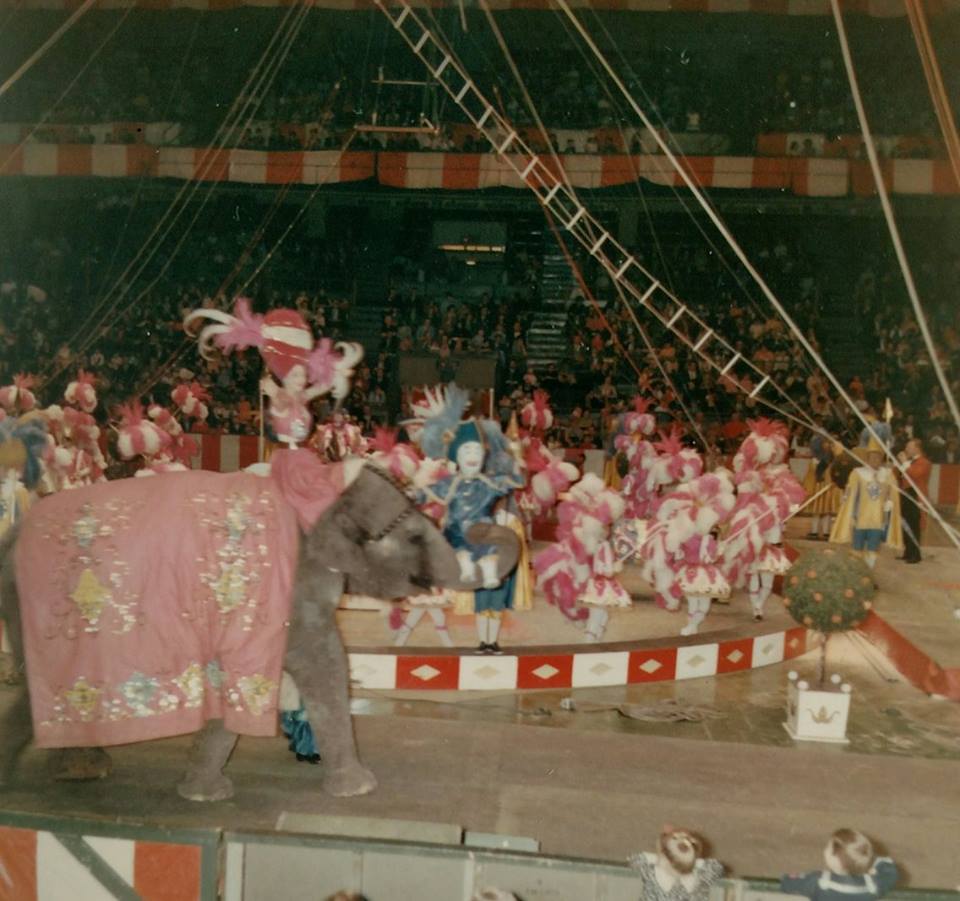
PRINCE PAUL ALPERT: Madison Square Garden

Photo courtesy of Beth Anne Duze Woolley

"Thought you might like this photo, my father took it at Madison Square Garden. My mother was Prince Paul Alpert's 1st cousin and as a child it was always a thrill to see him leading the big parade riding an elephant."


Wednesday, May 18, 2016

IN MEMORIAM: Ken "Ken-Zo" Horsman


Kenneth L. Horsman, who performed as Ken-Zo the Clown in the Ringling Bros. and Barnum & Bailey Circus and later established a South Baltimore magic shop and entertainment center, died of melanoma cancer Thursday at his Federal Hill home. He was 58.

Born in Baltimore and raised in homes on Williams and Clement streets, he was the son of William V. Horsman, a merchant seaman, and his wife, Mildred Flippo, who worked in a printing company.
"A city boy, a shy, frustrated problem child, leaves town to join the circus. He becomes a clown and puts on a painted smile, unicycling around the sawdust track, juggling and coaxing smiles from children of all ages," said a 1981 Evening Sun profile of him. "Kenny Horsman's story is such a classic it's hard to believe it really happened."

"He was always an entrepreneur," said his son, Spencer Horsman, who followed his father as a comedy magician and escape artist. "He sold apples at the Cross Street Market to buy his first suit."
The 1981 article said Mr. Horsman had been a circus nut since a young age. His parents took him to the Civic Center each year, and he got ultimately got a job selling cotton candy when the circus was in town. "I used to hook school," he said in the article. He said he would leave his house for school, then take a bus or hike to a spot near the airport to attend the Clyde Beatty Circus. He and other boys would "help pull ropes and set up chairs" in exchange for free passes.

The article also noted that his English teacher at Southern High School, from which he graduated in 1977, recalled that Mr. Horsman "was a self-starter." While in school, he took a train to Washington to audition with the Ringling Bros. He was chosen to attend its Clown College in Venice, Fla., and was one out of 21 — from a class of 60 — to be offered a Ringling Bros. job.

"He became part of the crew sent ahead of the circus to talk to reporters and generate publicity and was named one of two 'boss clowns,'" the article said.

In 1981, after marrying an acrobat clown, Mary Bernadette "Bernie" Spencer, he gave up the circus life.

He returned to Baltimore and bought a house on Byrd Street while still appearing at birthday parties and store openings. He also opened a magic shop, Ken-Zo's on Light Street.

He ultimately found a new clown role as Ronald McDonald. For nearly 20 years he represented the McDonald Corp. in its Washington, Virginia and West Virginia restaurants. He also appeared at Ronald McDonald houses and other McDonald's-sponsored events. He worked congressional parties and once took breakfast to Sen. Bob Dole and his wife, Elizabeth, who headed the Red Cross. He appeared on stage at an event with Nancy Reagan.

In 1986, he located a large storefront for sale on South Charles Street just north of the Cross Street Market. He opened Ken-Zo's Party Place, where he sold magic paraphernalia and party supplies. He also had a room for children's birthday parties.

"He appeared in a movie with Tom Selleck called 'Her Alibi.' He was cut from the film but made $30,000 in 10 days. He put the deposit on this building," his son said.

"When people come in, it's a happy feeling, a great feeling — like, what's behind that door?" he said of his business in a 2005 Baltimore Sun article. "This is a very giving business. The reward of it is to make other people laugh. How many people can say they do that?

"If you can't have fun in a store like this," he said, "then you're not going to find any fun anywhere."
In 2007, Mr. Horsman renovated the South Charles Street building and renamed it the Illusions Magic Bar and Theatre. He managed the place with his son, who performs his magic and entertains guests at the popular venue.

Mr. Horsman remained at Illusions until his death.

A service of remembrance will be held at 2 p.m. Saturday at Illusions Bar and Theatre, 1025 S. Charles St.

In addition to his son, survivors include his wife, Marissa A. Villalobos; two brothers, Earl Horsman of Baltimore and William Horsman Jr. of Sumter, S.C.; two sisters, Tina Stevens of Red Lion, Pa., and Mary Jane Mann of Oregon; and nieces and nephews. His first marriage ended in divorce.


Tuesday, May 17, 2016

Monday, May 16, 2016

POLIDOR: Final Resting Place Discovered


Thanks to the considerable efforts of Jeff Solimando at the Trentonian newspaper the final resting place of the legendary Ringling Bros. and Barnum & Bailey circus clown Edward Guillaume, better known as Polidor, has been discovered in Hamilton Township, NJ.

Mr. Guillaume passed away in 1964.

'Nuff said.


Sunday, May 15, 2016

ROYAL HANNEFORD CIRCUS: Salaam Shrine, Mennen Arena

Thank you to Billy Martin, the Royal Hanneford Circus and the Salaam Shrine, Clowns and Clown Alley for a great run at the Mennen Arena in Morristown, NJ this weekend.


Photo courtesy of Glen Heroy

Thursday, April 28, 2016

BEN LINDER: (July 7, 1959 – April 28, 1987)

Courtesy of the Zinn Education Project


“My son was brutally murdered for bringing electricity to a few poor people in northern Nicaragua. He was murdered because he had a dream and because he had the courage to make that dream come true.”

- Ben Linder's mother, at his funeral.

In addition to volunteering as an engineer, Linder participated in vaccination campaigns, using his talents as a
clown, juggler, and unicyclist to entertain the local children. Linder and two Nicaraguans—Sergio Hernández and Pablo Rosales—were killed in a Contra ambush on April 28, 1987. Linder was wounded by a grenade and then shot at point-blank range in the head. Read more and find the free downloadable teaching guide on Nicaragua, including a section on Linder, here: http://bit.ly/1PSeCdJ


Monday, April 25, 2016

VARIETY (April 9, 1909)

Marceline

A national organization is being organized by the circus clowns of the country. The first step was a meeting of the Hippodrome funmakers, under the leadership of Marceline, held in the Hippodrome dressing rooms a few days ago. The purpose of the association is not protection, but social. The following committee was appointed to carry the movement further: Marceline, George Holland, James R. Adams, Clyde Powers and Frank Hansen, of the Hippodrome; Al Miaco and George Hartzell, of the Ringling Bros.' Circus, and Spader Johnson and Fred De Voe, of the Barnum-Bailey organization. Wells Hawks, the public disseminator of "The Hip," furnishes the information.

Friday, April 22, 2016

CLOWN ALLEY: Barnum & Bailey; Variety (April 20, 1907)


The press department of the Barnum-Bailey show last Saturday "pulled off" a publicity-seeking scheme with its clowns, which brought forth comment in the dailies not relished by the funny men. A large auto carried the entire force of clowns to the Consolidated Stock Exchange on lower Broadway, where they disembarked. All excepting Steve Miaco and Bell, of Bell and Henry, proceeded to the gallery, but these two marched in the pit to be marched out again almost immediately after some rough handling by the brokers who did not consider the intrusion comical.

Thursday, April 21, 2016

AL MIACO Variety (April 1907)


    Al Miaco, one of the principal clowns with the Ringling Brothers' show this season is the oldest engaged actively in the ring. Mr. Miaco is father of Steve, at present a principal funmaker in the Barnum-Bailey aggregation. "Miaco" has been a standard circus name for years. There was a "Tom Miaco" years ago, who was a clown, and lived in Cortland N. Y. The history of the Miacos in the show business if compiled would fill a large volume. Everyone up 'York State believes Tom to have been the original clown of that name.


Wednesday, April 20, 2016

SLIVERS OAKLEY: Variety (April 1907)


At the premiere of the Barnum & Bailey show at the Garden last week "Slivers" Oakley, the chief clown, "walked off" in the middle of the performance. Questioned regarding this proceeding Slivers said: "I attempted to do some quiet pantomime work several times, but on each occasion attention was diverted from my efforts by the passing of a number of other clowns with slapstick comedy. This, of course, rendered my efforts void and there was nothing left for me to do but retire. I explained my position to the management and they saw the reasonableness of my attitude. Matter were immediately adjusted and I am now working at every performance in perfect harmony with the others."

Tuesday, April 19, 2016

CLOWN BAND: Ringling Bros. Circus (1897)

    A Symphony in Q Flat

    Being an Attempt to Describe a Subject That Baffles Description.

    Josh Billings wrote more wisely than he knew when he paraphrased an old saying thus: “Music hath charms to soothe a savage, to rend a rock, or split a cabbage.” But “Josh” never heard the Ringling Brothers’ Clown Band, consequently must have taken his “cue” from some wandering son of “Sunny Italy,” whose inspired afflations emanated from the bellows of a barrel organ and breathed out upon defenseless Nature the soul-soothing melody of “Silver threads amongst the gold,” while concomitantly “de monk ” danced the variations.


Clown Band
The Clown Band
But the “Real Thing” really never happened until the year of grace, 1897, when Spader Johnson and his musical coadjutors established that now famous musical organization known as the “Clown Band.” When its organization was completed Euterpe smiled, for the sweet-faced muse knew that the divine art of music, over which she had presided so many centuries, was to rise to heights hitherto unattained, and that the soul of Spader and his symphonious swallows — or, in other words, Johnson and his jabbers of wind would scale the very peaks of the mountains of melody, and from the dizzy heights roll down upon a breathless and expectant world an avalanche of melody and engulf all mankind in an ocean of music. Did the glorious muse divine aright? Well, rather, and why not? Was not this collateral company composed of the very crem de la crem of the musical world? and had they not as director and cornet virtuoso that greatest of all living leaders, Spaderowski Johnsonicola, whom the vulgar once called Spader Johnson? Was the baton ever held in a hand that could so direct the impulses of his players and sway the multitude? When he waved his magic wand with the majesty of an emperor, were not the hearts of his musicians touched like when the winds of a tropical evening awaken into life the responsive chords of an aeolian?

But Johnsonicola was not only great as a director. He had but to breathe into the small end of his cornet, and lo, from the large end canaries seemed to flutter, filling the air with melody so sweet the thousands listened in mute wonder, for the sounds were such as had never been heard on this prosaic earth before, and a poet, who one day heard them, with beautiful sentiment, called them “unearthly.” But the great Johnsonicola could not only soothe his hearers with the sweetness of his playing; he could play so as to make their hearts as light and gay as a May morning, and then again he could touch the hidden depths of human passions and parade before the listener the more somber hues of melody. A man of deep feeling, he could display among the lighter tints the shadows of sadness and make the audience melancholy, so that many of them shed tears, and all agreed that it was very painful indeed. Such was Johnsonicola.

Those whose souls breathed through their various instruments at his supreme command were equally eminent in the musical world. Great among these great ones was Signer Spaghetti Natalie. A native of Greece, he learned as a child to worship art. Beneath that soft southern sky he listened to the native musicians, and on many a moonlit night drank in the melody of the boatmen’s songs that floated o’er the waters to his island home.

The musical nature thus fostered in the land of art was intensified by a residence in later years on Halstead street, Chicago. His instrument was the flageolet. Upon it he was never known to play a tune, but someone — I forget who — said he was h— on after-beats. An ardent worshiper of Nature, Signer Spaghetti Natalie found his greatest pleasure, musically, in reproducing her sounds. Patti could sing like a canary, Jenny Lind acquired the title of the Swedish Nightingale, but no one yet had learned to warble like the great American hog. But Natalie did it with the help of his yellow flageolet and thereby won the name of — but why bestow titles which the great musician’s inborn modesty would cause him to disclaim? Besides the memory of that euphonious squeek will always live with those who heard it. How can it be explained? Imagine a grand symphony played at twilight at the entrance of the stock yards and the porcine plaudits of the inmates blending with the music. Such were Natalie’s after-beats as they marched out in solid columns and vanished in the ozone, gone but not forgotten.

Signer Bickeloni was a fiery musician, if the term may be used. In fact, he was regarded as a warm member — of the band. He could make his cornet talk a language all its own. Signer Bickeloni played with that style and grace characteristic of great musicians. He never had to hunt through the whole scale for a tone, but took the most convenient of the register offered and made the most of it. He was always noted for going right after a tone and hitting it hard. If the tone “sassed back,” which was very seldom, he hit it again and sent it “bing-bang” until lost in the bale ring. His methods seemed to differ somewhat from Ole Bull’s. The latter rather coaxed his tones from his instrument. Bickeloni “never coaxed nothin’,” but, with uncompromising majesty and musical pre-eminence, went at a tone in a manner to make it wail. His methods were best adapted to the somewhat vigorous Wagnerian school. The glory of Bickeloni’s playing was in his trill. Who that ever heard that trill can forget it? It was most conspicuous in the andante passage of Watsonalli’s trombone solo, “Rocked in the Cradle of the Deep” in Q minor. The following bars exemplify the beautiful effect:

Watsonalli — Da rah de rah r-r-r rah da d’ deep,
Bickeloni — Un-tilly-lilly-lilly-tilly-lilly leap.
Watsonalli — De re ruh r-r-row de de duh week,
Bickeloni — Um-tilly-lilly-tilly-lilly tr-r-r-r-r-reap.

The beautiful blending of these two parts can only be imagined by the “way-up-uns” among musical critics. If you are not one of us don’t try; it’s too deep for you. Signer Watsonalli, the world-famous trombone soloist, to whose soul-stirring, omnium-moving genius Bickeloni’s obligate was played, is as original as he is effective. He could make the painful and tearful effects in music even more painful and more tearful than the author intended. In fact, he could depict misery to such perfection that the audience were always miserable during his “effort.” He had that masterful power of reaching out with his music and getting close to everyone within the big tent and compelling attention. No one could escape his magic power. His breath no sooner passed through his trombone than everyone knew it. It was a kind of knowing, too, that left no doubts. Whether the tones were split out in great sheets, stamped out in big chunks, or rolled out in rafts, there was always that positive quality about his music that removed all doubt as to his being all there and getting there too. He was, compared to all other trombone players, like a ripe pumpkin to “yaller” cucumbers.

Signor Lewis Sunlinasco is the name of the famous bass of all basses. Few are aware of the fact that when the Signor arrayed himself under the baton of Johnsonicola a dispute relative to certain technical points in music arose between the two. Sunlinasco believes in the motto, “ Be sure you’re right then go ahead.” He had struck a note on his tuba which he judged was right and refused to vary it, and “ on this line,” said he, “ I propose to fight it out if it takes all summer.” Johnsonicola was forced at last to acknowledge that Sunlinasco could get as great a variety of effects with that one tone as many another could on the whole register.

Signor Zammerti was another famous musician. His performances were remarkable for the great range of his playing. His range was unparalleled. It extended from pedal C to high E and from the bell of his tenor horn to almost anywhere within the confines of creation. Heiser used to listen for it in the stand ahead to know whether the show had started on time or not. The canvasmen claimed that it tore holes in the side wall of the big top as, like a bird uncaged, it burst from confinement and made its unfettered way over the prairies. So much for Zammerti and his range.

This account would be incomplete without a brief mention of the drummers of this wonderful band. Signor Tenori Drumanzi Jonezie was the great solo tenor drummer of the organization. He had, as few know, a most deliciously delicate touch in handling the ebony sticks. Of course no one would dare to criticise such a great artist, but if a suggestion were in order here, it might perhaps be said that his playing was just a shade too classical for the imperfect musical standard of most audiences. He avoided all pyrotechnical displays, which are the usual stock in trade of snare drummers, and confined himself to the music as it was “wrote.”

Signor Jimminie Westo Hitterhardo needs no mention here. His beating of the big bass drum is without a parallel in the history of this most tuneful instrument. He always struck out from the shoulder, and while he was on the strike all season he never once seemed displeased with his job. His crescendos were beautiful, his andantes perfection, and his diminuendos a revelation to musicians and a source of never-ending delight to all who heard him.

Signor Majorbatoni Turnouri, the marvelous manipulator of the drum major’s baton, added to the musically perfect organization a certain degree of finish and imposing grandeur that could not otherwise have been attained. He dropped his baton during the entire season only 12,047,963 times, a most remarkable record. Such was the Clown Band. Will its like ever be heard in this land again? The chances are it may, but hope whispers maybe “ nit.”

Sunday, April 17, 2016

ICHOF: Foolish Fundraiser


"Let us be thankful for the fools. But for them the rest of us could not succeed"- Mark Twain

Six years ago today a great friend of the ICHOF, and Board member, Sandy Weber designed this wonderful logo as we moved forward to re-opening this little place where clowns are celebrated, stories are remembered and lives dedicated to laughter are shared with old and new generations. 
We we opened our doors to the public on May 21, 2010 in our new home of Baraboo, Wisconsin. since that date we have had thousands of guests visit us in person and view the most amazing collection of clown artifacts in the world. We hope they leave with a smile & respect for this art form and share our mission with their family and friends. Our presence on social media has allowed us to bring images and information to potentially millions of people world wide who appreciate clowning as the craft that it is, respect those individuals who's careers have elevated laughter to the most needed medicine for what ails us as a human race, and inspires those who are looking to fufill the calling in their life called clowning.
How perfect the timing that a museum that honors the humor in our lives began on this day known to our society as April Fools Day.
With that, the Board of Directors of the International Clown Hall of Fame and Research Center is proud to announce a "FOOLISH FUNDRAISER" to begin today April 1, 2016 and conclude on the Anniversary day of our opening in Baraboo, Wi, May 21, 2016.
Our goal is for us to raise $10,000 in the next 51 days.
Our 2016 plans include adding substantially to our artifact collections, digitizing and making avaiable online our vast photo archives, the transfer to digital dvd of thousands of feet of rare movie films, new display fabrications and continuation of our Oral Histories project. These goals can only be met with your help.
We will be including incentives to those who can help us reach this attainable dream. Please visit our website at www.theclownmuseum.com where a link to PayPal is located. For today, April 1,2016, in honor of this day celebrating fools, anyone donating $100.00 to $200.00 will recieve a limited edition Jim Howle poster honoring the very first 5 Inductees into the International Clown Hall of Fame.

Titled, "The Pit Stop", it features Lou Jacobs, Otto Griebling, Red Skelton, Emmett Kelly, Felix Adler and Mark Anthony. These are limited edition high quality poster prints.
Every day between today and May 21,2016, the ICHOF will offer an incentive and grateful thank you to those who can donate and help preserve our shared clown heritage. Check back here and on our webpage daily for a suprise and a sharing of clowns worldwide!

Please tell your friends, clown fans and people in your life that could use some laughter!

Wednesday, April 13, 2016

CLOWN ALLEY: Polack Bros Circus (1954)

A Shrine date hospital visit with Professor Charlie Cheer, Harry Dann, Rudy Dockey and Lou Jacobs

Sunday, April 10, 2016

OTTO GRIEBLING: Cole Bros. Circus (August 25th 1937)


Otto Griebling with guest clown, circus fan and Seattle area publisher of the Wenatchee Daily World Rufus Woods who travelled with the show for a few weeks. The photo is available from Getty Images by clicking HERE.

Friday, April 01, 2016

INTERNATIONAL CLOWN HALL OF FAME: APRIL'S "FOOLISH FUNDRAISER From Director Greg DeSanto


"Let us be thankful for the fools. But for them the rest of us could not succeed"- Mark Twain

Six years ago today a great friend of the ICHOF, and Board member, Sandy Weber designed this wonderful logo as we moved forward to re-opening this little place where clowns are celebrated, stories are remembered and lives dedicated to laughter are shared with old and new generations. 

We we opened our doors to the public on May 21, 2010 in our new home of Baraboo, Wisconsin. since that date we have had thousands of guests visit us in person and view the most amazing collection of clown artifacts in the world. We hope they leave with a smile & respect for this art form and share our mission with their family and friends. Our presence on social media has allowed us to bring images and information to potentially millions of people world wide who appreciate clowning as the craft that it is, respect those individuals who's careers have elevated laughter to the most needed medicine for what ails us as a human race, and inspires those who are looking to fufill the calling in their life called clowning.

How perfect the timing that a museum that honors the humor in our lives began on this day known to our society as April Fools Day.

With that, the Board of Directors of the International Clown Hall of Fame and Research Center is proud to announce a "FOOLISH FUNDRAISER" to begin today April 1, 2016 and conclude on the Anniversary day of our opening in Baraboo, Wi, May 21, 2016.

Our goal is for us to raise $10,000 in the next 51 days.

Our 2016 plans include adding substantially to our artifact collections, digitizing and making avaiable online our vast photo archives, the transfer to digital dvd of thousands of feet of rare movie films, new display fabrications and continuation of our Oral Histories project. These goals can only be met with your help.

We will be including incentives to those who can help us reach this attainable dream. Please visit our website at www.theclownmuseum.com where a link to PayPal is located. For today, April 1,2016, in honor of this day celebrating fools, anyone donating $100.00 to $200.00 will recieve a limited edition Jim Howle poster honoring the very first 5 Inductees into the International Clown Hall of Fame.

Titled, "The Pit Stop", it features Lou Jacobs, Otto Griebling, Red Skelton, Emmett Kelly, Felix Adler and Mark Anthony. These are limited edition high quality poster prints.

Every day between today and May 21,2016, the ICHOF will offer an incentive and grateful thank you to those who can donate and help preserve our shared clown heritage. Check back here and on our webpage daily for a suprise and a sharing of clowns worldwide!


Please tell you friends, clown fans and people in your life that could use some laughter!